Sunday, 13 April 2014

Which Door Will it Be?

Source:  Here

Announcing a Jane Austen Society of Ireland lecture: 'Mansfield Park After 200 Years', to be given by Professor Darryl Jones, from Trinity College, Dublin.

This is an invite-only event, for members of the JASI, taking place this week, at a secret location in the heart of Georgian Dublin.

If you are a fan of our esteemed Jane, then there is no better time to join our Society and participate in our bespoke Austen events. To attend this wonderful evening's entertainment, you must join the Society in the next day or two. (Membership numbers must be quoted on entry).  Please note that seating is limited, so become a member now to avoid disappointment.


Sunday, 6 April 2014

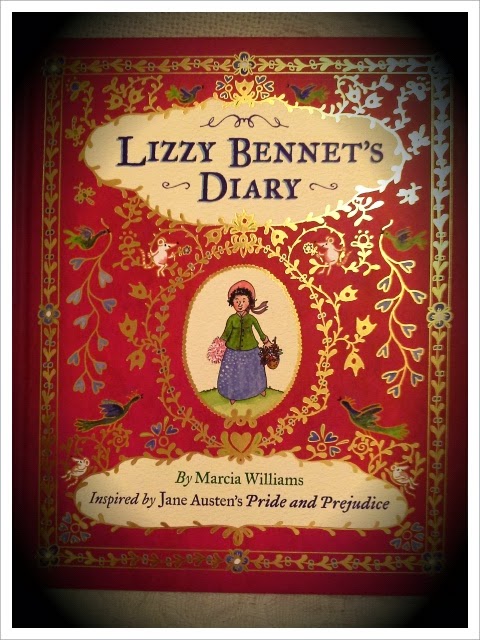
Lizzy Bennet's Diary ~ by Marcia Williams

This is a sweet little book, full of witty references to Jane Austen's 'Pride and Prejudice'.  As with every proper diary, it is crammed full of detailed observations and private comments about those around her.  As such, the book reads like a summary of Austen's novel, with additions relating to every day life - such as favourite fabrics and  ribbons; mementos and  souvenirs.  This works particularly well, because we experience so much of the novel from Elizabeth's point of view.  

However, there are times that the Lizzy in William's book says some things that Austen's Lizzy would never say, such as 'Although Charlotte does not like me to
mention it, she is already twenty-seven years old - nearly ten years my senior!'  Of course, the real Elizabeth Bennet would never say such a thing, and certainly would not refer to her dearest friend as an 'old maid' as Williams's Lizzy does.  I suppose that is the draw-back of condensing a long novel into such a concise format: much character development is omitted.  The brevity of the text is a little unsettling and at times the book is overly-simplistic, with Lizzy occasionally sounding too much like Lydia and Kitty - obsessing about ribbons and balls - than our beloved heroine.

There are over twenty letters in Austen's novel, and some of them feature here.  They are handwritten in beautiful fold out pages, and, as in the original text, they allow us to hear directly from the other characters in the novel, such as Mr Collins, Mrs Gardiner and Fitzwiliam Darcy. Some letters are copied verbatim from the mother text, while others are fabricated entirely from Williams's imagination.

We catch glimpses of Mr and Mrs Darcy, at home, at Christmas, preparing for dinner with Georgiana and the Gardiners.  Such delicious flights of fancy are what make this book worth having.

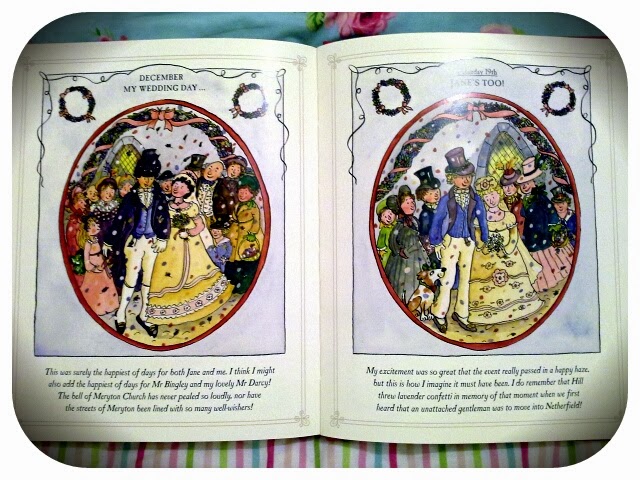
But let us not forget the wonderful illustrations that accompany the book - Marcia Williams is clearly an
illustrator first and a writer second.  They are full of detail and will draw you to the book again and again.  They may lead you to believe that the book is more suitable for a younger audience, but I think that readers who are very familiar with Austen's novel, probably older book-lovers, will get a great kick out of the many in-jokes and references.

That said, there is much to enjoy in this book, for readers of every age.  Well, how could it fail? It is inspired by the great Austen herself!
(c) Michelle Burrowes 


First published on MyBookAffair.net  February 2014

Sunday, 16 February 2014

Jane Austen and The Real Princess

Letter of February 16th, 1813 to Martha Lloyd

"I suppose all the World is sitting in Judgement upon the Princess of Wales's Letter. Poor woman, I shall support her as long as I can, because she is a Woman, & because I hate her Husband -- but I can hardly forgive her for calling herself ``attached & affectionate'' to a Man whom she must detest -- & the intimacy said to subsist between her & Lady Oxford is bad -- I do not know what to do about it; but if I must give up the Princess, I am resolved at least always to think that she would have been respectable, if the Prince had behaved only tolerably by her at first. --" 
 Today, some 201 years ago, this was what preoccupied Jane Austen's thoughts.  While the behaviour of The Prince Regent, George Augustus Frederick, Prince of Wales, causes little concern to modern readers, it is Austen's strong reaction to his attempt at divorcing his wife, Princess Caroline of Brunswick, that is indeed very interesting.

Such a passionate, open expression of dislike for the future King of England, is extremely surprising in Austen, and is testament to her modern-thinking and strong sense of justice; or is it?   Brought into the spotlight earlier than expected by the undeniable madness of his father, King George III, The Prince Regent was an unpopular royal; despised for his extravagance and gluttony, and often lampooned in the popular press by cartoonists and journalists alike.  So perhaps Austen's readiness to chide the future king was not so unexpected after all; it was socially acceptable.

However, her declaration, in this private letter to her friend, that she supports Caroline, 'because she is a
woman', surely tells us something of Austen's outlook on gender.  She rebukes the princess mildly who, in a letter to her husband, that was later made public, addresses him as 'His Royal Highness'.  Austen says,  'I can hardly forgive her for calling herself  `attached & affectionate'' to a Man whom she must detest.'  Here Austen seems to feel a natural affinity to the put-upon Princess because they are of the same gender.

As a daughter of a clergyman, with no rights or entitlement to property or land, the Austen women knew something of being short-changed in a male-dominated society.  Jane and her sister Cassandra had been left homeless on their father's death because they had never married, and here was Princess Caroline, a married woman, having her rights and entitlements undermined by the highest in the land.  It  is not difficult to see why Jane Austen supported the Princess's claim for legal entitlement.

Of course, the irony is that Austen herself would use the very same phrase, 'His Royal Highness',  three times when she came, albeit reluctantly, to dedicate her novel 'Emma' to the prince, at his request, in December of the following year. Knowing Austen and her sense of humour though, she was no doubt enjoying her own little joke at his expense, and showing her clear support, once again, and this time in public, for a mistreated wife, and woman.

And as for Caroline - despite being supported by the British people, she was refused admittance, as Queen, to the King's coronation, three years after Austen's own death, in 1821.  She arrived at Westminster Abbey, only to be turned from the door by armed guards and forced to go home.  She took ill, later that night, and died three weeks later.  (The cause of her timely death has never been proven and some think she may have been poisoned.)  While she was ill, she had time to write a new will, requesting that she be buried in her native Germany, with an inscription on her tomb reading:  'Here lies Caroline, the Injured Queen of England'.  The new King George IV remained as unpopular as Jane Austen had known him to be, for the rest of his reign.

Sunday, 2 February 2014

Spring Cleaning, Austen Style

Spring is officially here and what better time to dust off your old copy of Mansfield Park, and get reading. We at The Jane Austen Society of Ireland are preparing for a get together next month, with Trinity College professor, Darryl Jones.

As luck would have it, Mansfield Park is one of his favourite books, and Jane Austen one of his favourite authors.  He has offered to give the JASI a special 'bicentenary birthday lecture' on the novel, that is bound to entertain and inspire, but we will let you know the specific details at a later date.   

In the meantime, you have just enough time to read (or re-read) the book that is arguably Austen's most political work.  With so many editions of this great book out there - it may well be the year to buy yourself a nice hardback, commemorative edition, so what are you waiting for?

Wednesday, 1 January 2014

Welcome 2014 ~ The Year of 'Mansfield Park'

2014 promises to be another important anniversary year for Austen fans, for it was two hundred years ago that Jane Austen published her fine novel, Mansfield Park. Some critics, including biographer Paula Byrne, list this as their favourite Austen novel, it being the text most favored by Cambridge scholars, such as F.R. Levis, who hailed it as one of the greatest English novels ever written.

The novel itself was penned at Chawton Cottage between February 1811 and 1813 but was published in May 1814 by Thomas Egerton, who published Jane Austen's two earlier novels, Sense and Sensibility and Pride and Prejudice.  The image on the left comes from a beautiful illustrated edition from 1957, showing Fanny at the window, astonished to see William Crawford coming to call on her.  It is a book about making choices, mistakes and finding love right under one's nose.  In this way, Mansfield Park is not very different from Austen's two previous novels, yet this book gives us a real insight into what it was to be a woman without any financial means, completely at the mercy of rich relations, who deserve little respect or admiration.  It is certainly a book to brush away those winter cobwebs and get you thinking.   
So, if you have never read Fanny Price's story, now is the time. There will be no better way to celebrate Austen in 2014.  Happy New Year everyone!

Monday, 23 December 2013

Merry Christmas Everyone!

We at the Jane Austen Society of Ireland would like to wish all our members, and Austen fans everywhere, a very merry Christmas and a peaceful New Year.

This was the year that we celebrated the bicentenary anniversary of the publication of 'Pride and Prejudice', so if you haven't yet read Austen's hugely popular novel, you still have a week or so to finish it before the end of this anniversary year.

This was also the year that we established the Jane Austen Society of Ireland, held our premiere event in the beautiful Farmleigh and published our first society journal, The Austen Gazette. We'd like to thank you all for the support and encouragement in all of these endeavours and look forward to more events and publications in 2014.  

But the Austen treats are not over yet.  Remember to tune in to BBC One to catch 'Death Comes to Pemberley', a sequel to Austen's novel, which was written by P.D. James and directed for television by Daniel Percival.  The story will be told over three nights this holiday season and promises to have us all enthralled.  

Merry Christmas Everyone!


Death Comes to Pemberley starts on BBC One on 26 December at 2015 GMT and continues on the 27 and 28 December 2013

Sunday, 15 December 2013

Happy Birthday Jane!

December 16th is the day, more than any other, that we think and remember Jane Austen, for that was the day that she was born.

On the following day, December 17th 1775, Rev. George Austen wrote to Mrs.Walter (wife of his half-brother William Hampson Walter.)

"You have doubtless been for some time in expectation of hearing from Hampshire,and perhaps wondered a little we were in our old age (he was 44 and his wife Cassandra was 36!!) grown such bad reckoners but so it was, for Cassy certainly expected to have been brought to bed a month ago: however last night the time came,and without a great deal of warning,everything was soon happily over.We now have another girl,a present plaything for her sister Cassy and a future companion.She is to be Jenny,and seems to me as if she would be as like Henry as Cassy is to Neddy. Your sister thank God is pure well after it..."


Jane (not Jenny) was privately baptised the day after her birth but,as the winter of 1775-6 was one of the bitterest for many years, she was not taken to Steventon Church for a public christening until April 5th 1776.

By Eileen Collins Cork.